

If you have to buy something, check prices with at least two suppliers. Here’s how the law of diminishing returns plays out at 2 a.m. on the train station in the middle of nowhere.
I’ve got a few distinctive traits – like being an even 2 meters tall (about 6.7) or a voice that could pass for a hammer drill. When I became a manager in early 2015, I was also a textbook dumb-ass – full of the self-confidence and drive common to those of my kind. Whatever has changed since then is thanks only to the people I met along the way and the simple truths they managed to drill into me. One of those people was Maciej, and one of those truths is the one about the “second cab.”
How do you keep from getting ripped off when it’s time to buy something? Where’s the bare-minimum analysis you should run? How does a seasoned banking consultant make those calls?
The Worst Kind of Consultant
Maciej was a former consultant, a stocky guy full of energy and tact. He always wore a shirt, which was always tucked into trousers, which were always held up by a belt – an upstanding citizen. Although he’d only recently joined our firm, in general he was probably working longer than I’d been alive. “When a bank has a nasty job to do,” he explained, “they hire the Big Four consultants. When the job is so nasty that even the Big Four invoke a conscience clause, they call independent ones." And that’s exactly what Maciej had been for the previous ~20 years – "the worst kind of consultant", as he put it.
We were driving to a conference at some hotel on the outskirts of Warsaw. The 2.2-liter diesel in the company Ford was howling at a speed that made it obvious we weren’t the ones paying for the maintenance. As the senior colleague, somewhere near the A1 entrance Maciej temporarily adopted me and now he was lecturing – plainly, with no puffery – about the job. Meanwhile, still totally green, I was experimenting with my latest discovery in management and human relations – I shut up and listened. The payoff came quickly: it was then that Maciej told me what, after closer study, turned out to be the best, most pragmatic take on the “law of diminishing returns” in analytics I’ve ever encountered.
Check the Other Cab
“If you’re in a strange city at 2 a.m. and need to get back to your hotel” – said Maciej – “don’t hop into the first cab you see, because they might rip you off. Don’t waste time checking every cab either – you don’t have that kind of time. Always call two cabs.
- If one fare is much higher than the other – you know it was a scam.
- If both fares are roughly the same – you know that’s just the going rate.
- A third or any later cab probably won’t change much – go get some sleep.”
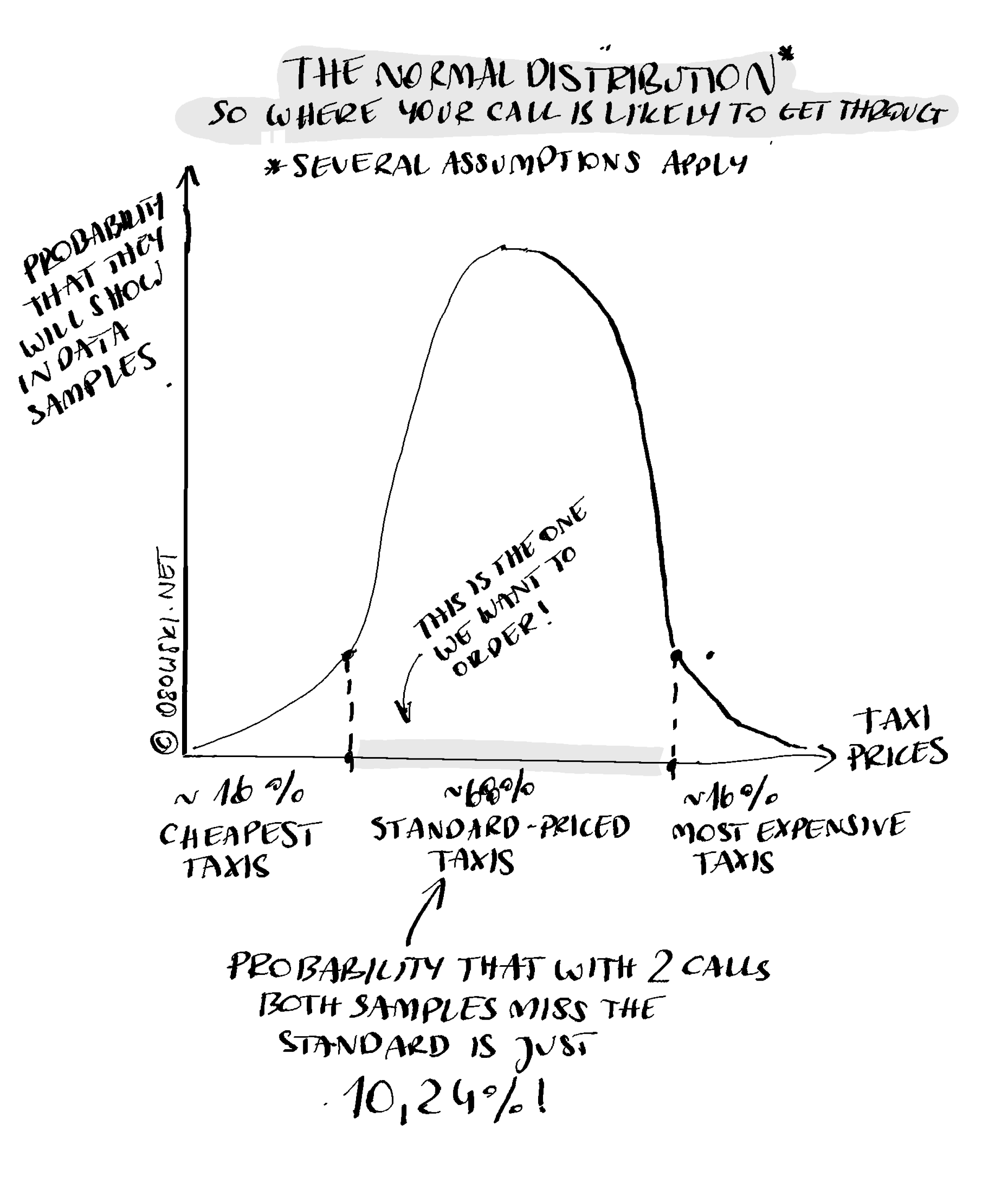
Thanks to Uber and Bolt, the risk of getting cheated by a blood-thirsty street-side hustler outside the station is far lower today. Yet the universal lesson Maciej shared with me still applies whenever you have to decide fast with little time for analysis. Two independent data points from the same pool have a decent chance of representing the whole set. Relying on just one point means no analysis at all. Looking at three or more points is (sometimes) a luxury. The arbitrary threshold Maciej illustrated with taxis is two data samples.
The Law of Diminishing Returns and Information Gain in Analysis
The law of diminishing returns says that:
- When you keep increasing one input (e.g., ringing up more taxi companies)
- while holding every other factor constant (e.g., it’s still 2 a.m. in the middle of nowhere)
- in pursuit of the best outcome (e.g., picking the quickest to get, best-priced cab)
- …you eventually reach a point where adding even more of that input no longer raises your payoff – payoff actually starts to fall. ❶
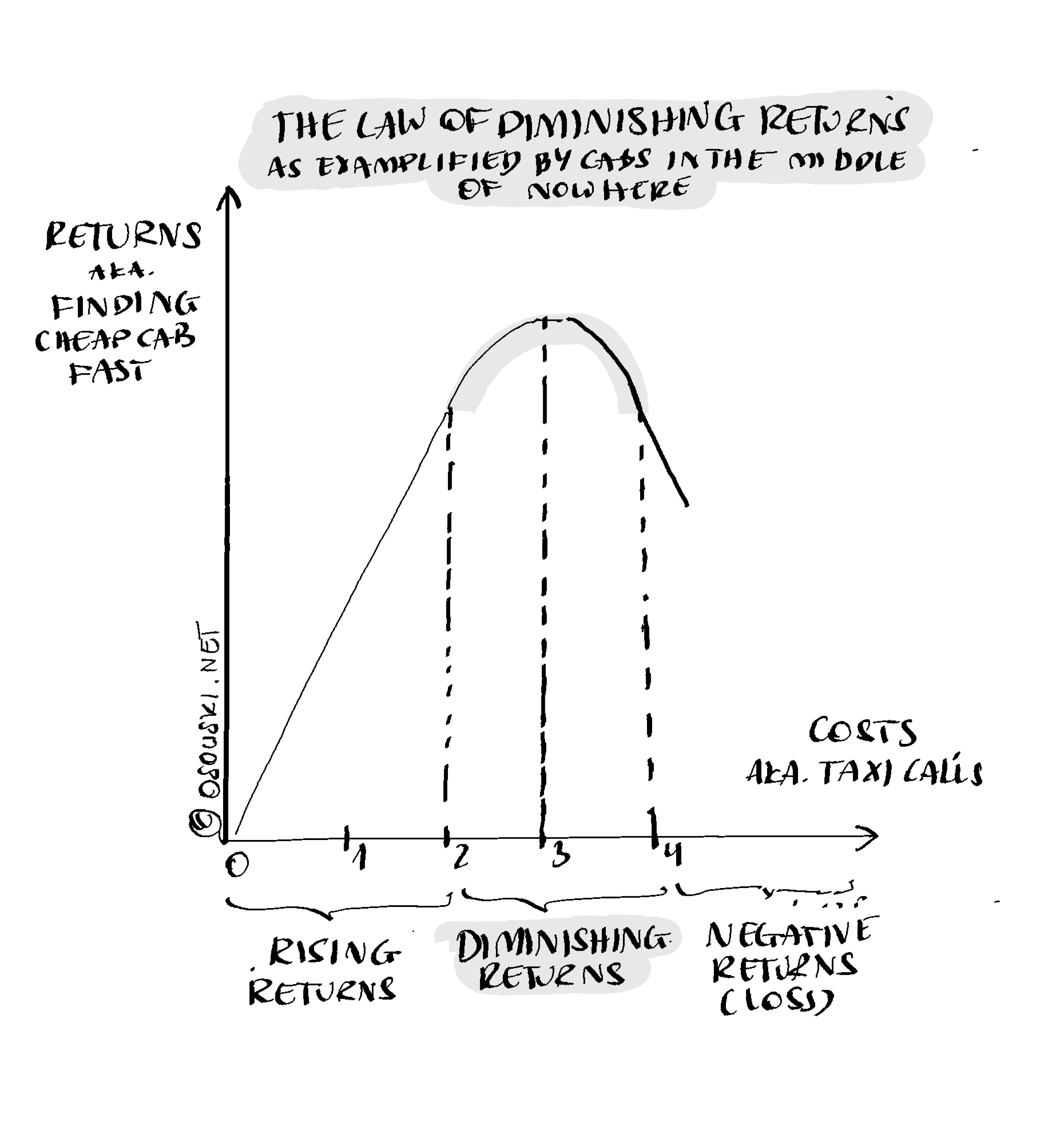
Even though this rule is one of the basic laws of economics – every sneaker producer or onion grower knows it – seeing it applied to analysis felt fresher than anything the mentioned two could ever supply.
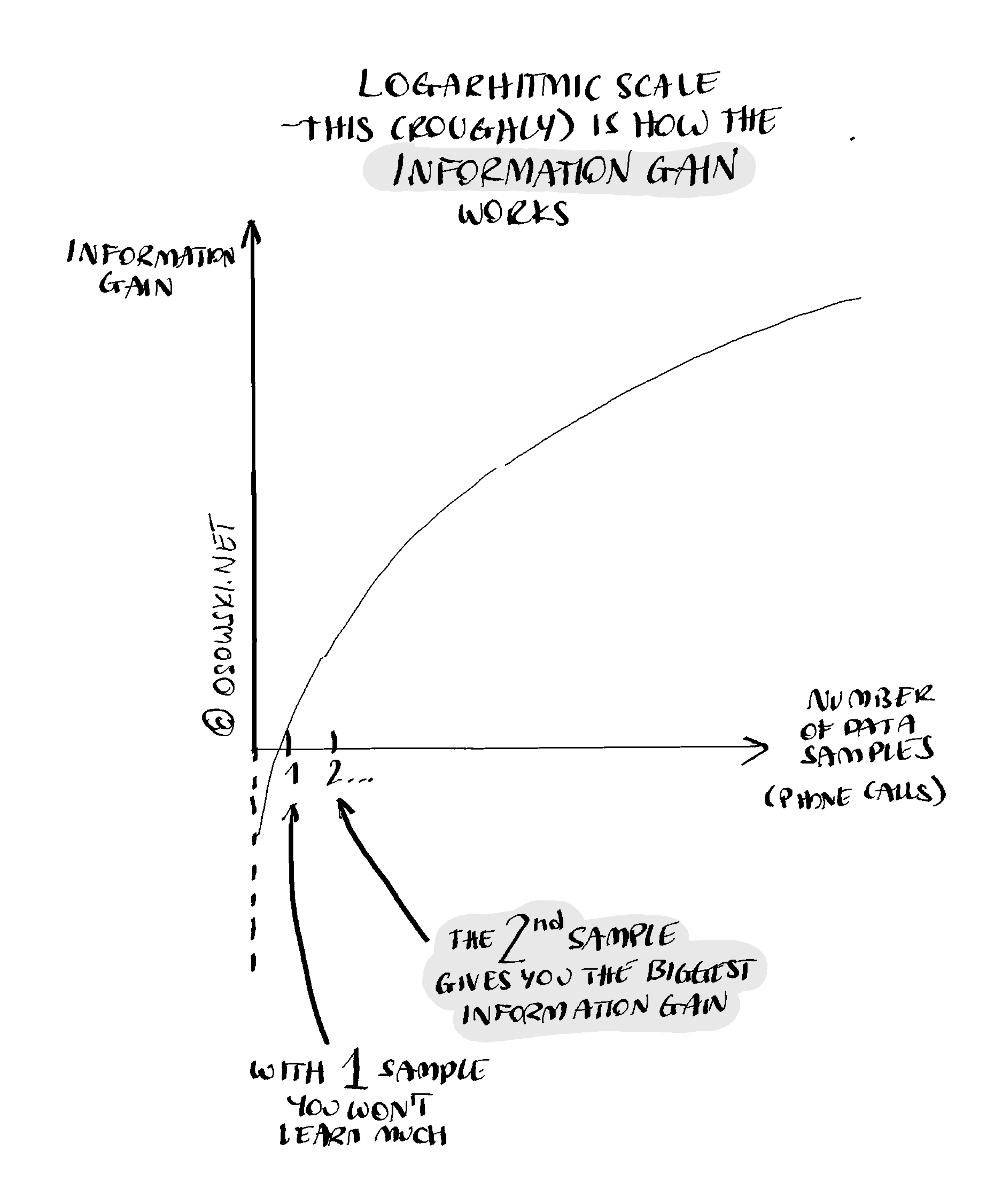
Over time I realised that Maciej’s taxi story is a textbook example of what information theory and machine learning call “information gain.” According to the Neyman–Pearson lemma ❷❸, said gain not only follows the law of diminishing returns but does so (a) exactly as the sample’s probabilities dictate and (b) with results that grow on a logarithmic scale.
The difference? You can explain Maciej’s rule in a roaring 2011 Ford doing 130 km/h on a freeway while eating a McWrap – those other theorems, not so much.
When to Use the “Two-Cabs” Rule?
In practice, “check the other cab” has become one of my go-to requests. I pull it out whenever my team and I know little or nothing about something today but want to look informed and confident in about a week, tops. Here are 3 real-world examples of its use:
- Choosing a log-management tool (this year) – We were ready to go with an ELK-as-a-Service setup, but to be safe we’re also running a Grafana Loki POC, so we have at least 2 data points.
- Rebuilding the team (last year) – We kept each hiring track open until we had at least 2 candidates in the second round for every role, just for comparison.
- Picking a new contract (this life) – After landing the first offer that satisfied me, I still finished another interview process to double-check how the market valued my skills. In the end, Allegro offered me more take-home on a standard employment contract (UoP) than the competition on a B2B deal.
Know any other golden rules that show up in analysis? I’d love your comments and links – especially the one time you couldn’t check a “second cab” and how it ended. If you think any of this might help you someday, drop “Thanks Maciej!” in the comments. The original Maciej already has a link to this article and will be thrilled to see it.